
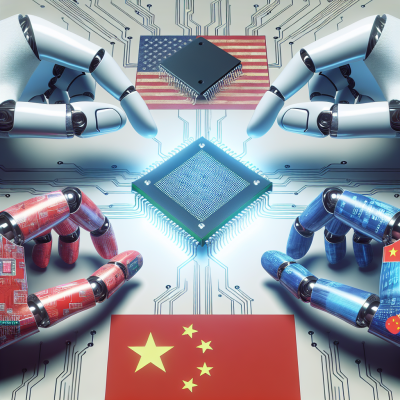
The Global AI Race Intensifies: China vs. the U.S.
The race to dominate artificial intelligence is accelerating, and the battlefield is centered around one critical resource—high-performance chips. In a critical showdown between China and the United States, the competition has reached a new stage, driven by technological prowess, economic strategy, and international policy maneuvering.
The Power of Nvidia Chips
At the heart of the AI arms race lies Nvidia’s powerful GPUs, especially the latest in its Rubin lineup. These chips are foundational for training large language models and powering next-generation AI applications in fields ranging from healthcare to defense.
However, global access to Nvidia’s top-tier processors is far from equal. According to industry insights, well-funded U.S. organizations are given priority access. Meanwhile, Chinese firms find themselves further down the queue, struggling to secure what’s available amid tightening export restrictions.
China’s Growing Demand vs. Limited Supply
Chinese tech giants—from startups to established players—are aggressively trying to get their hands on these chips. But the channel is narrow:
- Export controls imposed by the U.S. government limit the availability of high-end Nvidia chips to Chinese entities.
- Backdoor buying through subsidiaries or overseas branches is being scrutinized more heavily by regulatory bodies.
- Chinese firms are being outbid by U.S. competitors who often have greater resources and earlier access to new product lines.
This high-stakes chip scarcity is putting Chinese AI development at risk of lagging behind—not due to innovation deficits, but due to lack of access to the necessary training infrastructure.
U.S. Policy Plays a Key Role
The strategic decisions of Washington are shaping this global technology race. Through export restrictions aimed at safeguarding national security interests, the U.S. government is effectively slowing China’s AI advancement.
These include:
- Restricting Nvidia from selling its most advanced chips directly to Chinese customers.
- Tightening regulations on third-party semiconductor shipments that may eventually end up in China.
- Investing heavily in domestic AI infrastructure like chip manufacturing facilities and quantum computing.
These policies illustrate how AI has become not just a matter of innovation, but of geopolitics.
The Growing Divide in AI Development
As the competition escalates, a clear divide is forming between East and West AI capabilities. While China has invested heavily in data ecosystems, algorithms, and workforce training, its dependency on the West—particularly the U.S.—for cutting-edge silicon remains a vulnerability.
American companies by contrast enjoy substantial advantages:
- First access to Nvidia’s latest technologies like the Rubin chips.
- Top-tier cloud infrastructure including AWS, Google Cloud, and Microsoft Azure.
- Stronger investor ecosystems that fuel AI startups with significant venture capital resources.
This growing gap could lead to divergence in global AI leadership that will shape the next decade of technological progress.
China’s Strategy Amidst Constraints
Despite the hurdles, China is not standing still. It is responding with a multi-pronged approach:
- Investing in domestic chip capabilities, including through companies like SMIC (Semiconductor Manufacturing International Corp).
- Focusing on AI software innovation that can potentially mitigate hardware shortfalls.
- Partnering with countries and companies outside U.S. jurisdiction to create alternative supply chains.
Yet, closing the gap in semiconductor manufacturing is a massive undertaking—both financially and technologically.
Nvidia’s Balancing Act
Caught in the middle is Nvidia itself. The company faces a complex challenge:
- Navigating U.S. export controls and global customer demand.
- Protecting its commercial interests in the massive Chinese market.
- Maintaining its leadership in AI chip innovation amidst geopolitical scrutiny.
By releasing chip variants that comply with U.S. policies but still serve computational power needs in China, Nvidia is trying to toe a delicate line—serving both markets without violating trade rules.
The Road Ahead: A Race with Global Consequences
The AI race is no longer just about who writes better algorithms; it’s about who controls the most critical hardware. As long as the U.S. holds the upper hand in chip technology, China’s AI aspirations will remain constrained. However, the long-term outcome depends on multiple factors:
- The evolution of U.S. export control policy.
- China’s success in semiconductor self-reliance.
- Disruptive innovations that may reduce reliance on current hardware paradigms.
One thing is clear: the stakes are higher than ever. From economic power to national security, the AI race between the U.S. and China is reshaping the future of global technology—and it all starts with who gets the chips.

Leave a Reply