
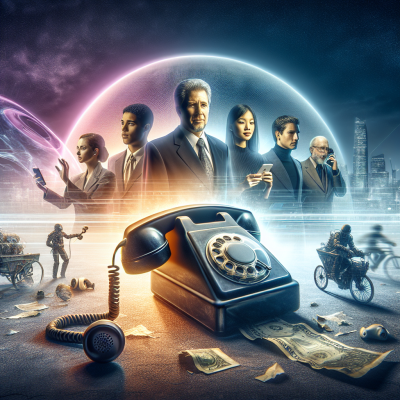
The Phone Is Dead: What’s Taking Its Place?
The Smartphone Era Is Nearing Its End
In the tech world, transformation is constant—and once again, disruption is on the horizon. For years, smartphones have been our lifeline. They’re our maps, messaging hubs, photo albums, and entertainment centers. But as innovation gains momentum, even our trusty smartphones may be living on borrowed time.
Tech futurist and founder of the stealth startup Sandbar, Callaghan, insists that the iPhone—and smartphones at large—are poised for extinction. “We’re not going to be using iPhones in 10 years,” he said flatly. “I kind of don’t think we’ll be using them in five years.” These are bold claims, but Callaghan is far from alone in his conviction.
A New Breed of Devices Is Emerging
So what’s replacing the smartphone? The next-generation devices promise to offer computing power, connectivity, and communication—but in radically different forms. Wearables, spatial computing, augmented reality (AR), and AI-driven interfaces are foreshadowing a future where physical screens are obsolete and the phone as we know it becomes invisible.
Meet Stream: The Anti-Smartphone
Sandbar’s first product, codenamed Stream, is rumored to be a discrete ring-shaped wearable that offers a radical departure from the phone experience. According to insiders, it’s designed to strip away the distractions of modern smartphones and elevate only essential interactions—what Callaghan labels “core slices of functionality.”
Rather than being an “everything” device, Stream focuses on the minimum viable connection experience. Think messaging, voice assistance, and location-based tasks without social media doomscrolling or ping after ping of notifications. It’s a minimalist rethink of connected life.
The Ring Interface: Form Meets Future
The center of this revolution? A simple wearable ring. Unlike smartphones that require visual and tactile engagement, the Stream ring may operate based on voice commands, AI prediction, gesture recognition, and haptic feedback. Its discreet design enables constant connectivity without breaking eye contact or interrupting conversations—a growing concern in our current phone-addicted lives.
Key Features Anticipated in Stream and Similar Devices
- Voice-first interfaces powered by contextual AI
- Gesture and haptic controls for intuitive interaction
- Always-on connectivity with minimal UI
- No social media, no screens – a digital detox by design
- Biometric feedback for personalization and security
What’s Driving This Transformation?
Several forces are converging to dethrone the smartphone:
- Screen Fatigue: As awareness grows around the psychological and physical impacts of screen overuse, consumers are hunting for alternatives.
- AI Takes the Wheel: With large language models and natural language processing improving rapidly, users can interact via spoken word rather than through touchscreens or apps.
- Ambient Computing: The idea that computing happens in the background—intelligently and unobtrusively—is reshaping product design.
- Spatial Technologies: With augmented and mixed reality tech maturing, physical screens may be replaced by environmental displays or even brain-interface devices in the long term.
Big Tech Is Already Leaning In
While Sandbar makes waves with its minimalist approach, giants like Apple, Meta, and Google are not standing idle. Apple is rumored to be working on second-generation AR glasses and deeper Siri integration. Meta’s Ray-Ban smart glasses and Project Aria are moving toward screenless interaction. Google continues to quietly invest in ambient smart home integrations and wearable experimentation.
The common theme? A shift toward more natural, embedded, and less distracting user experiences.
But Is the World Ready?
While early adopters and the wellness-conscious population may jump aboard the post-smartphone train quickly, mainstream adoption will take time. Questions about:
- Privacy and surveillance on wearable devices
- Battery life and connectivity infrastructure
- Transitioning workflows currently dominated by apps
…still remain to be answered.
Moreover, consumers are deeply integrated into smartphones—not just technologically, but culturally. Replacing them isn’t merely a hardware change; it’s a behavioral lifestyle shift.
Technology Moves Forward—Subtly
What makes Stream so compelling isn’t just the elimination of the smartphone. It’s the return to purposeful tech. While the smartphone evolved to serve every need—be it banking, working, dating, or gaming—it also became a place to waste time. Stream’s promise seems to be a reductionist return to essentials.
Callaghan is betting on quality over quantity: not how much your tech can do, but how gracefully it does it.
Final Thoughts: Long Live What, Exactly?
The phone may not suddenly disappear tomorrow. But the industry’s trajectory is clear. Smartwatches, earbuds, rings, glasses, and even ambient voice assistants are absorbing formerly smartphone-exclusive duties piece by piece.
As we stand on the precipice of change, the question is less “Will the smartphone die?” and more “What will rise in its place?”
The future of computing might be lighter, less visible, and more human-centric than ever before. And it could start with something as small as a ring on your finger.

Leave a Reply